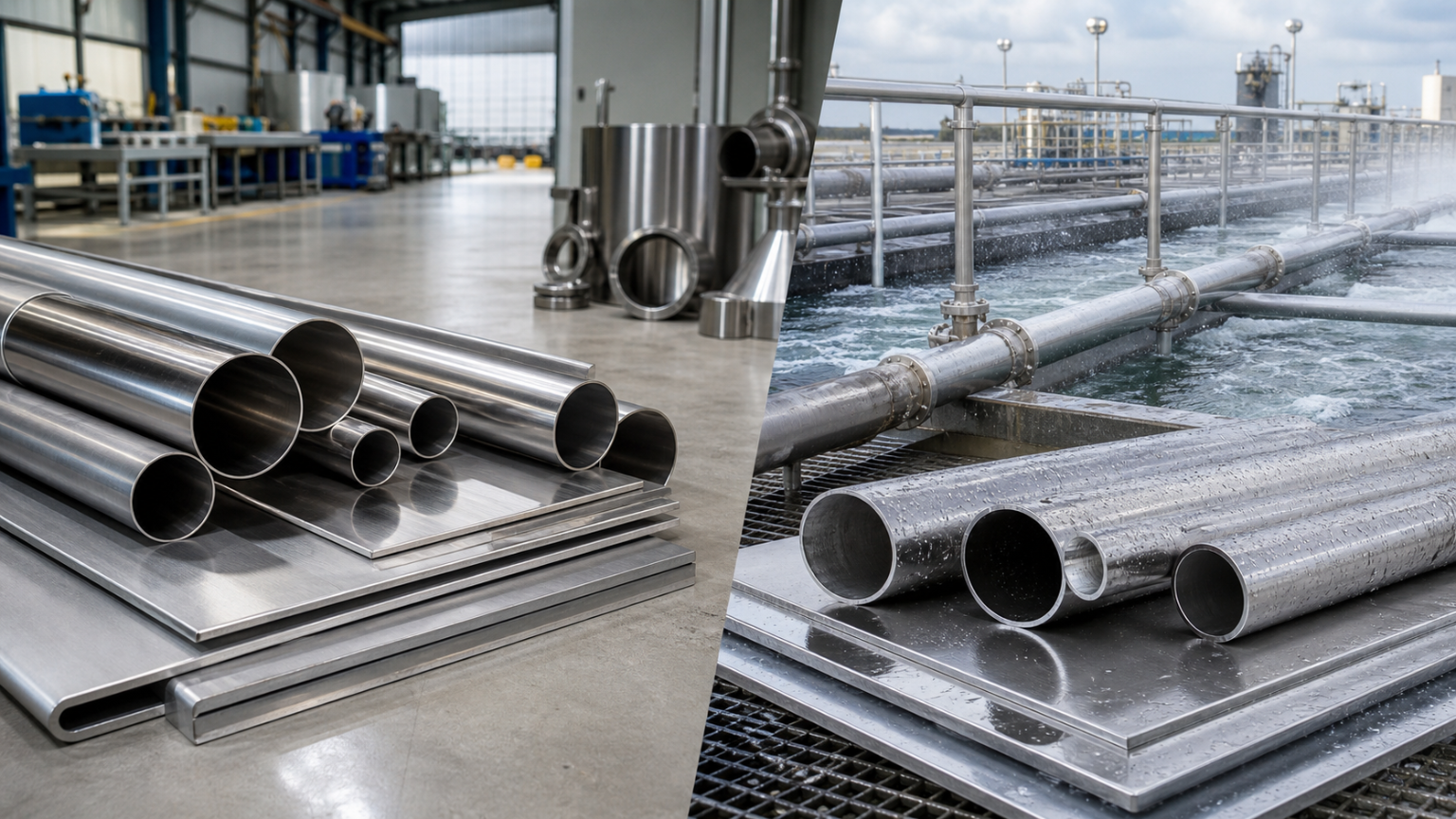
Choose 304 stainless steel when the environment is general construction or indoor/outdoor architectural use; choose 316 stainless steel when chlorides, marine exposure, chemicals, or water treatment conditions are part of the job. The biggest deciding factor is corrosion risk, especially chloride pitting. In our work as a stainless steel pipe and sheet manufacturer in Foshan, I usually tell buyers not to compare 304 vs 316 by grade name alone. Compare the application environment, welding requirement, product standard, surface finish, and inspection needs before you issue the RFQ.
| Dimension | 304 stainless steel | 316 stainless steel |
|---|---|---|
| Main alloy difference | Chromium-nickel austenitic stainless steel | Chromium-nickel-molybdenum austenitic stainless steel |
| Molybdenum | Not part of nominal 304/304L composition in the cited Alleima datasheet | 2.00-3.00 wt.% in the cited Sandmeyer 316/316L datasheet |
| Pitting resistance | PRE 18 for 304 / EN 1.4301 / UNS S30400 | PRE 24 for 316 / EN 1.4401 / UNS S31600 |
| Typical ZAIHUI application notes | Handrails, construction, commercial buildings, engineering projects | Marine environments, chemical plants, water treatment projects |
| Welding-sensitive choice | 304L | 316L |
| Cost position | Usually lower alloy cost | Usually higher cost because of molybdenum and higher alloy content |
Which resists corrosion better?
316 stainless steel resists chloride pitting better than 304 because it contains molybdenum, while 304 does not have molybdenum in its nominal composition. Sandmeyer lists 316/316L molybdenum at 2.00-3.00 wt.%, and BSSA explains that molybdenum helps reduce local chloride attack on the passive layer.
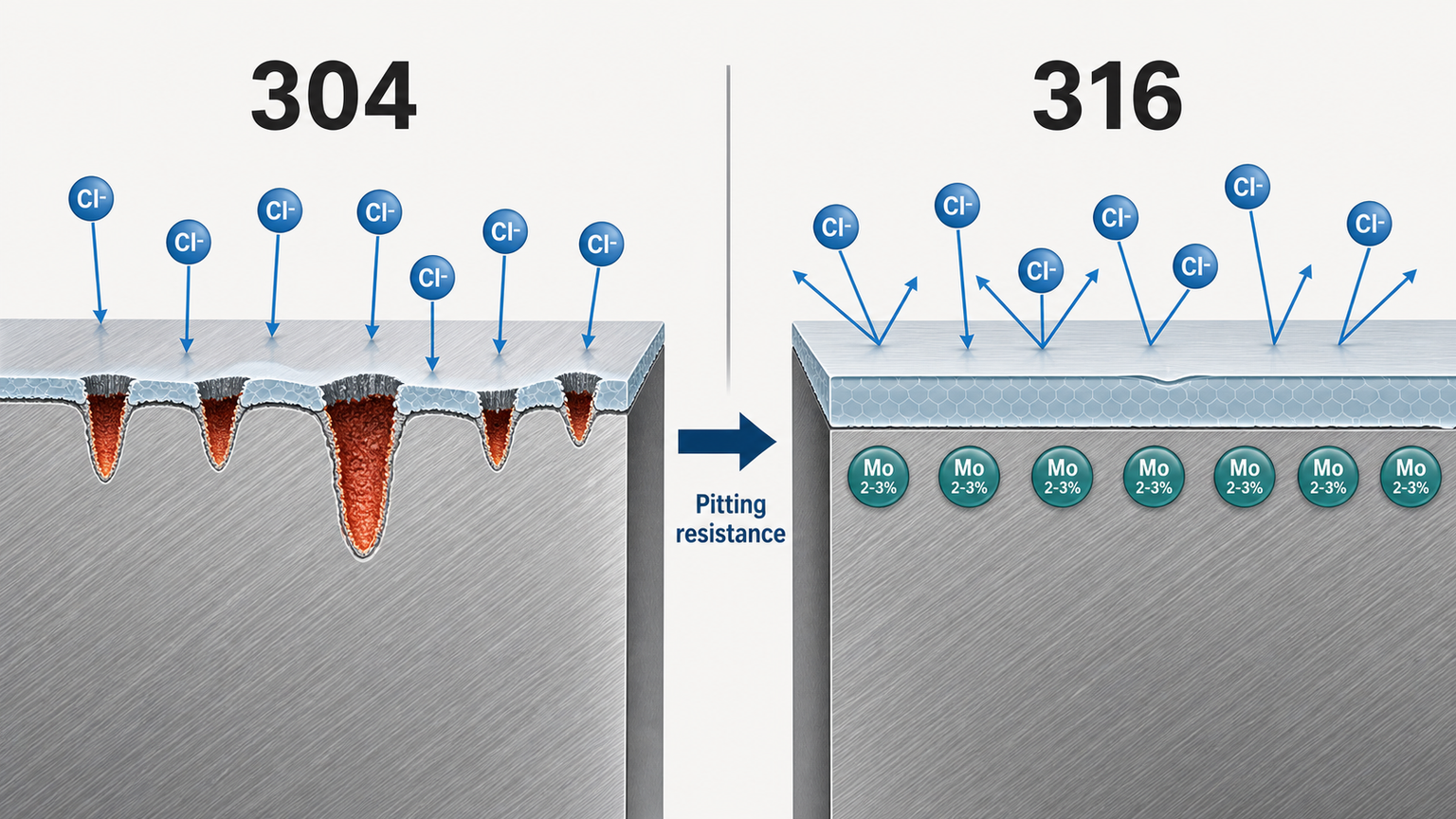
This is the main reason buyers move from 304 to 316. It is not because 316 is automatically “stronger” for every project. It is because chloride exposure changes the risk.
Outokumpu gives PRE as:
PRE = %Cr + 3.3 x %Mo + 16 x %N
That formula explains why molybdenum matters. Outokumpu lists typical PRE values of 18 for 304 / EN 1.4301 / UNS S30400 and 24 for 316 / EN 1.4401 / UNS S31600. A higher PRE indicates better pitting resistance.
For a buyer, the practical rule is simple. Use 304 stainless steel pipe or stainless steel sheet for general construction, handrails, commercial buildings, and engineering projects where the environment is not aggressive. Move to 316 stainless steel when the pipe, tube, or sheet may face chlorides, coastal air, chemical exposure, or water treatment conditions.
I remember a contractor in Southeast Asia who first asked for 304 decorative stainless steel pipe for an outdoor railing project near the coast. The important question was not only “304 vs 316 stainless steel?” It was whether salt air, cleaning chemicals, crevices, and surface finish would increase corrosion risk. That is the kind of detail that should be clear before buying.
Which is better for outdoor or marine use?
316 stainless steel is usually the safer choice for marine, coastal, chemical plant, and water treatment environments, while 304 is usually the value choice for normal outdoor construction. Chloride concentration, temperature, pH, redox potential, and crevice geometry all affect pitting and crevice corrosion, according to Outokumpu.
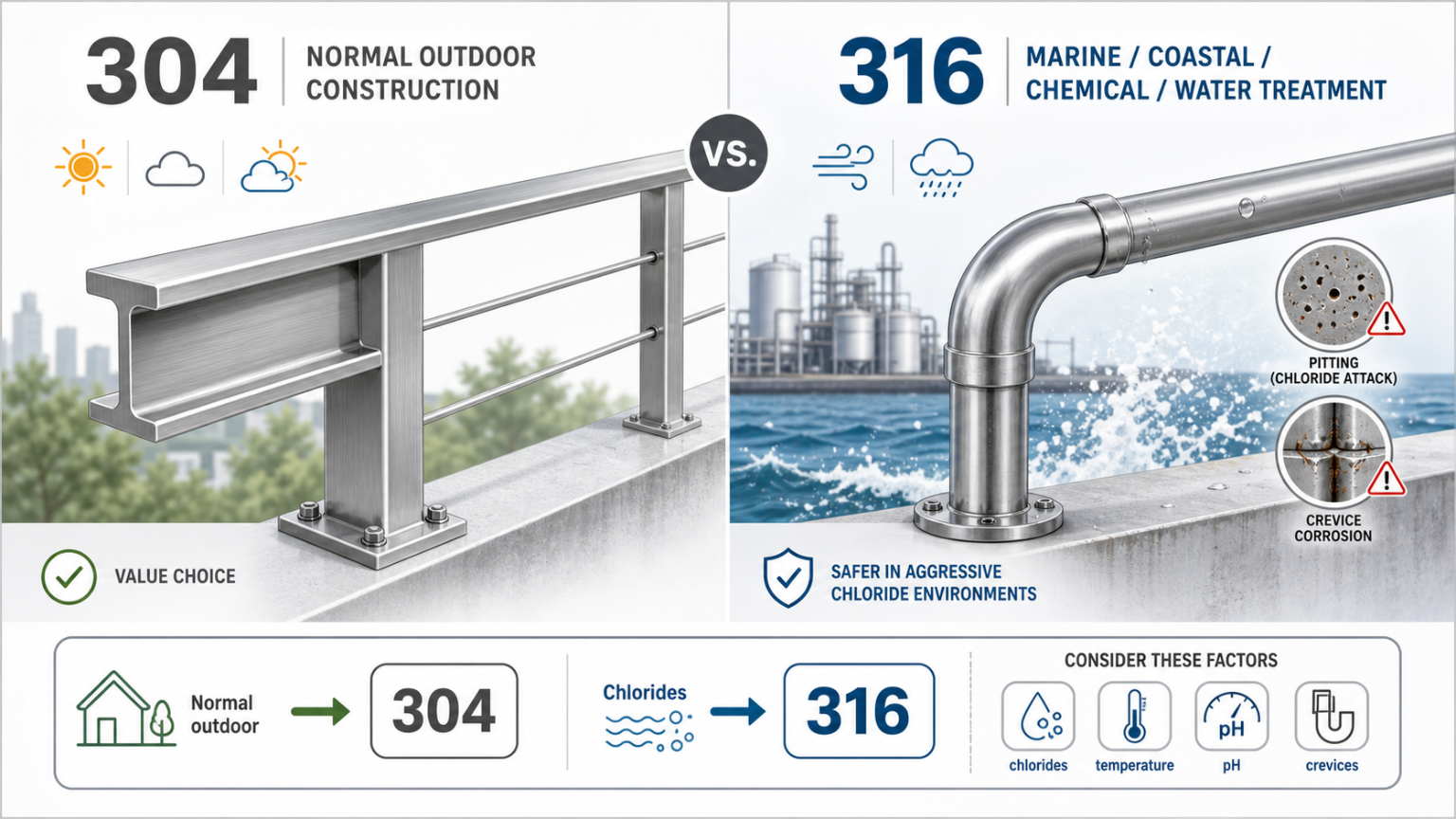
This is where many RFQs are too simple. A buyer writes “outdoor use” and asks for the best stainless steel. But outdoor use can mean very different things.
304 may be suitable for a commercial building handrail in a mild environment. It is widely used for handrails, construction, commercial buildings, and engineering projects in our own grade application notes. It gives good practical value when the exposure is not severe.
316 is a better fit when the environment includes salt, chemical cleaning, industrial atmosphere, or water treatment. Our internal notes place 316 in marine environments, chemical plants, and water treatment projects. 316L is also listed for high-corrosion environments, medical applications, and food processing industries.
Still, I do not call 316 rust-proof. That would be misleading. Stainless steel performance depends on exposure pattern, surface condition, cleaning, crevices, oxygen availability, and temperature. In a real RFQ, I would ask the buyer to describe the environment clearly instead of only naming a grade.
For outdoor stainless steel tube or sheet orders, we normally want these points checked:
- Application location: indoor, outdoor, coastal, chemical, or water treatment
- Product form: stainless steel round pipe, square pipe, rectangular pipe, decorative pipe, sheet, or plate
- Surface finish requirement
- Welding and fabrication process
- Cleaning chemicals or maintenance method
- Required standard, such as ASTM, EN, JIS, or GB
Which welds more safely?
304L and 316L are the better choices when welding corrosion risk matters because low-carbon grades reduce intergranular corrosion risk after welding. Sandmeyer lists 316L carbon maximum at 0.030%, compared with 316 carbon maximum at 0.08%.
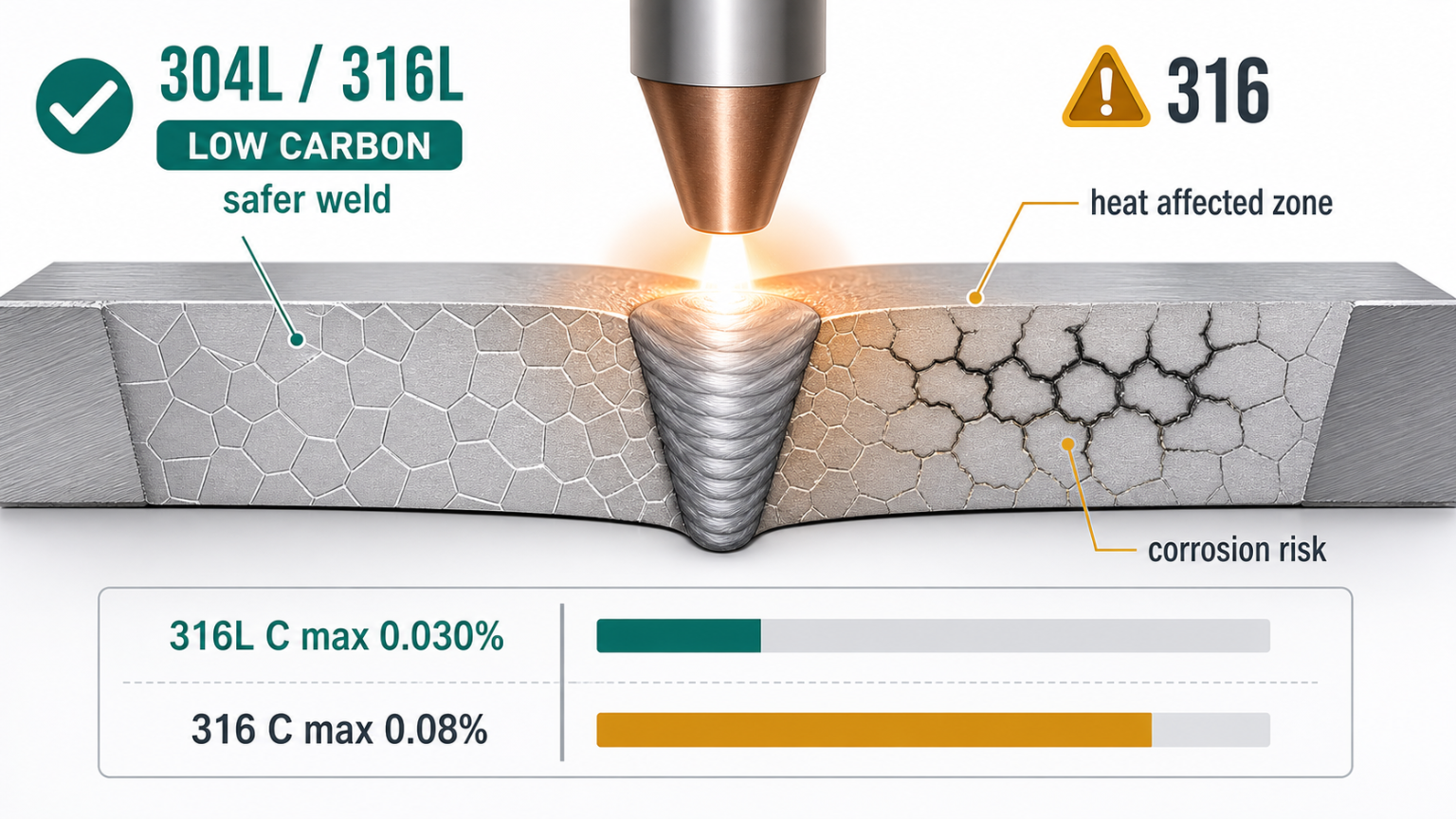
This does not mean every welded project must use an “L” grade. It means the welding condition and corrosion environment should guide the grade choice.
For general fabrication and construction, 304L is commonly selected when the project needs welding and corrosion sensitivity is a concern. In our own application notes, 304L fits welding projects and corrosion-sensitive environments. If the project also includes chlorides or more aggressive media, 316L becomes the more practical choice.
This is important for fabricators. A stainless steel pipe may look correct on delivery, but welded joints can become the weak point if the grade is not suitable for the environment. The buyer should not only ask for “304 pipe” or “316 pipe.” The buyer should state whether welding is required and whether the welded area will face corrosion risk.
For a welded stainless steel pipe or stainless steel sheet order, I would confirm:
- Whether the project requires 304L or 316L
- Welding process and fabrication method
- Post-weld cleaning or surface treatment expectations
- Product standard, dimensions, and tolerances
- Whether MTC or EN 10204 certificate type is required
- Whether PMI is required by the project
Which standards should buyers specify?
Buyers should specify the product standard by product form, not only by grade, because 304 and 316 can be supplied as pipe, tube, sheet, or plate under different ASTM, EN, JIS, and GB standards. ASTM A240 covers stainless steel plate, sheet, and strip, while ASTM A312 covers austenitic stainless steel pipe for high-temperature and general corrosive service.
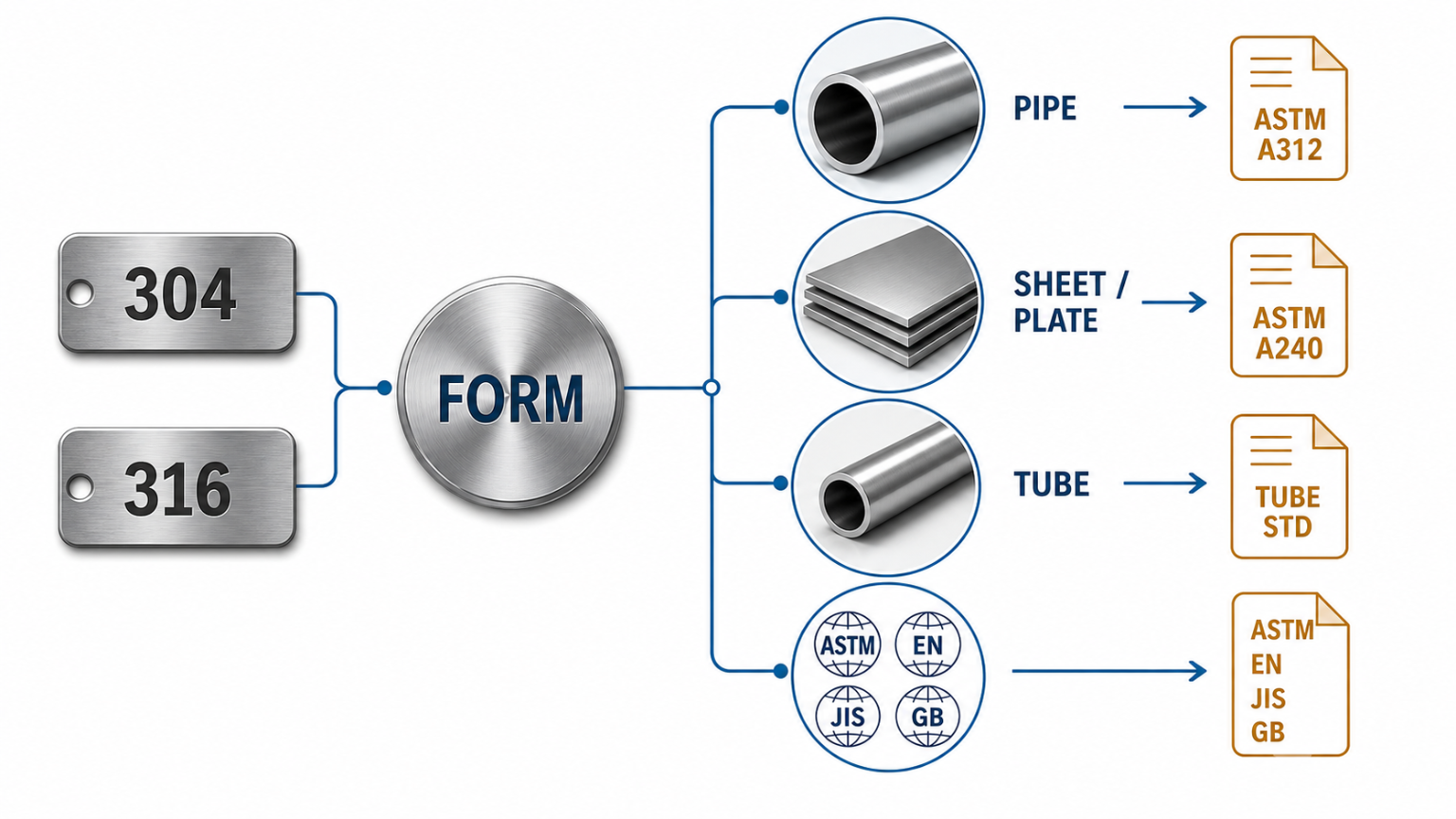
This is a common procurement problem. A buyer asks for 316 stainless steel, but the supplier still needs to know whether the order is for sheet, plate, process pipe, mechanical tube, or decorative stainless steel pipe.
For sheet and plate, ASTM A240/A240M covers chromium and chromium-nickel stainless steel plate, sheet, and strip for pressure vessels and general applications. EN 10088-2 covers technical delivery conditions for hot or cold rolled stainless steel sheet, plate, and strip for corrosion-resisting steels for general purposes. GB/T 3280-2015 covers cold rolled stainless steel plate, sheet, and strip.
For pipe, ASTM A312/A312M covers seamless, straight-seam welded, and heavily cold-worked welded austenitic stainless steel pipe for high-temperature and general corrosive service. EN 10217-7:2021 covers welded stainless steel tubes for pressure purposes and pressure/corrosion-resisting applications. GB/T 12771-2019 covers welded stainless steel pipes for fluid transport, and GB/T 14976-2025 covers seamless stainless steel pipes for fluid transport.
For decorative or mechanical tube, ASTM A554 covers welded stainless steel mechanical tubing for ornamental, structural, exhaust, and other uses. It includes round, square, rectangular, and special shapes. That matters for buyers sourcing stainless steel round pipe, stainless steel square pipe, rectangular pipe, or decorative stainless steel pipe.
At ZAIHUI, buyers often ask about ASTM, EN, JIS, and GB stainless steel pipe standards. We manufacture stainless steel pipes and sheets, including round pipe, square pipe, rectangular pipe, decorative pipe, thread pipe, sheet, and plate. The correct standard should be part of the RFQ, not something decided after production.
Which costs less?
304 stainless steel usually costs less than 316 because 316 contains molybdenum and has higher alloy content. I do not recommend using a fixed 304 vs 316 price difference because price changes with nickel, molybdenum, product form, thickness, finish, quantity, and freight.
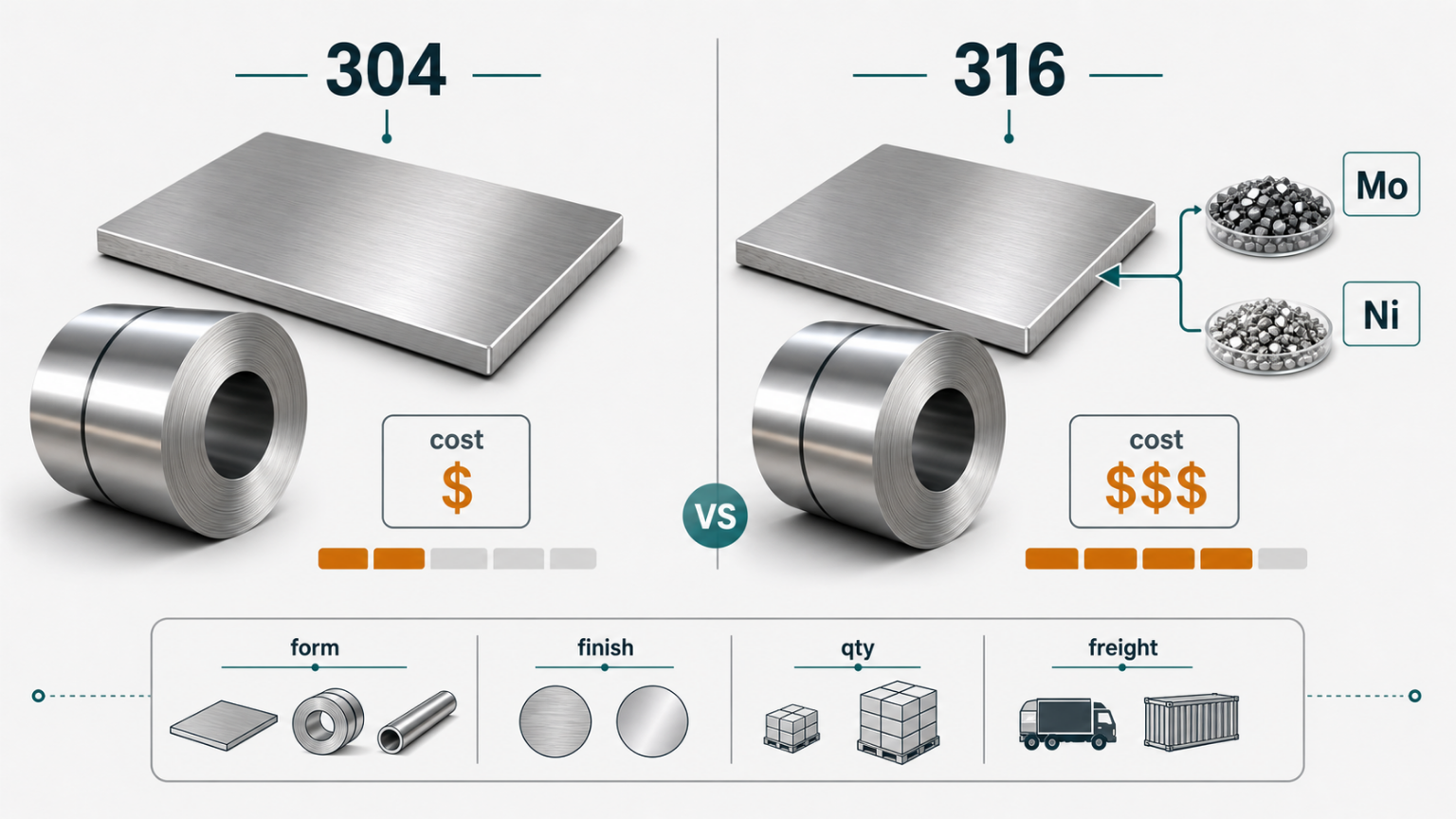
For procurement teams, the cheapest grade is not always the lowest-cost choice. If 304 is used in a chloride environment where 316 is needed, the total cost may rise through replacement, cleaning, rejected material, or project delay. If 316 is used where 304 is fully suitable, the buyer may spend more than needed.
This is why I prefer a fit-based comparison. 304 wins when the project needs good general corrosion resistance, wide availability, and practical value for construction, commercial buildings, handrails, and engineering work. 316 wins when the service environment justifies the higher alloy cost.
For distributors and importers, stable supply also matters. ZAIHUI has 130+ production lines, 28 direct sales branches, and 500+ distributors. We supply stainless steel pipe and stainless steel sheet customers worldwide. Those facts do not replace technical evaluation, but they are relevant when buyers need repeat supply across multiple product forms.
In an RFQ, I suggest buyers state the grade and the business reason behind it. For example, “304 stainless steel square pipe for indoor commercial handrails” is clearer than “304 pipe.” “316L stainless steel sheet for a welded component in a corrosion-sensitive environment” gives the supplier a better chance to check the right material route.
How do you decide between 304 and 316 stainless steel?
Choose 304 when the environment is general and cost control matters; choose 316 when chlorides, chemicals, marine exposure, or water treatment conditions raise corrosion risk. If welding and corrosion risk are both important, compare 304L and 316L instead of only 304 and 316.
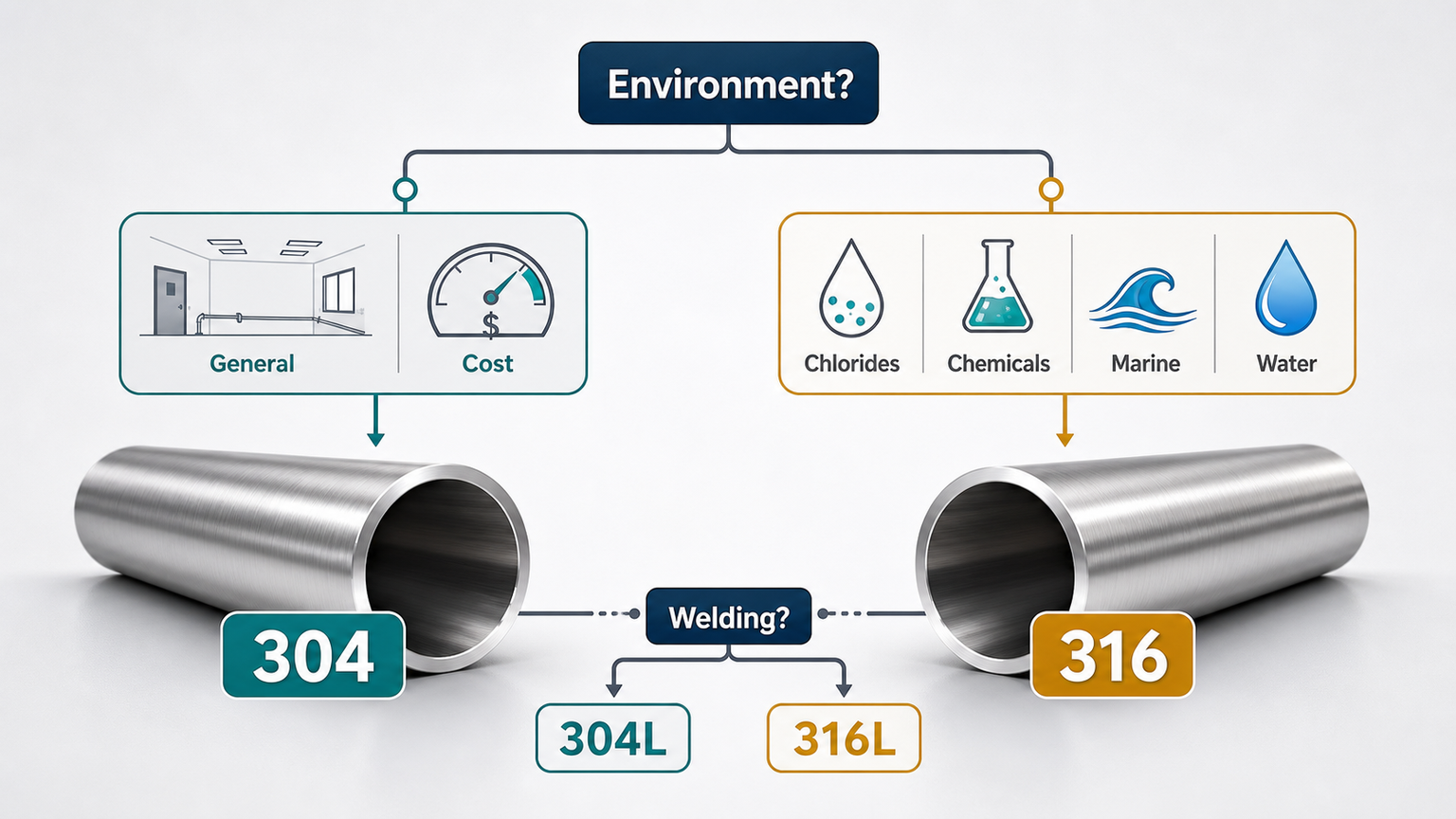
Choose 304 stainless steel if:
- The project is for handrails, construction, commercial buildings, or general engineering.
- The environment is not coastal, chemical, or high-chloride.
- The buyer needs good practical value for stainless steel pipe, stainless steel tube, or stainless steel sheet.
- The product will be fabricated under normal construction conditions.
- The RFQ can clearly define standard, dimensions, tolerance, and finish.
Choose 316 stainless steel if:
- The project is in a marine, coastal, chemical plant, or water treatment environment.
- Chloride pitting or crevice corrosion is a real concern.
- The buyer wants higher pitting resistance, with PRE 24 instead of PRE 18 for 304.
- The application justifies the higher alloy cost.
- The project specification already calls for ASTM 316, UNS S31600, EN 1.4401, or JIS SUS316.
Choose 304L or 316L if:
- Welding is required.
- Intergranular corrosion risk after welding matters.
- The project environment is corrosion-sensitive.
- The buyer needs the low-carbon grade stated clearly on the MTC and RFQ.
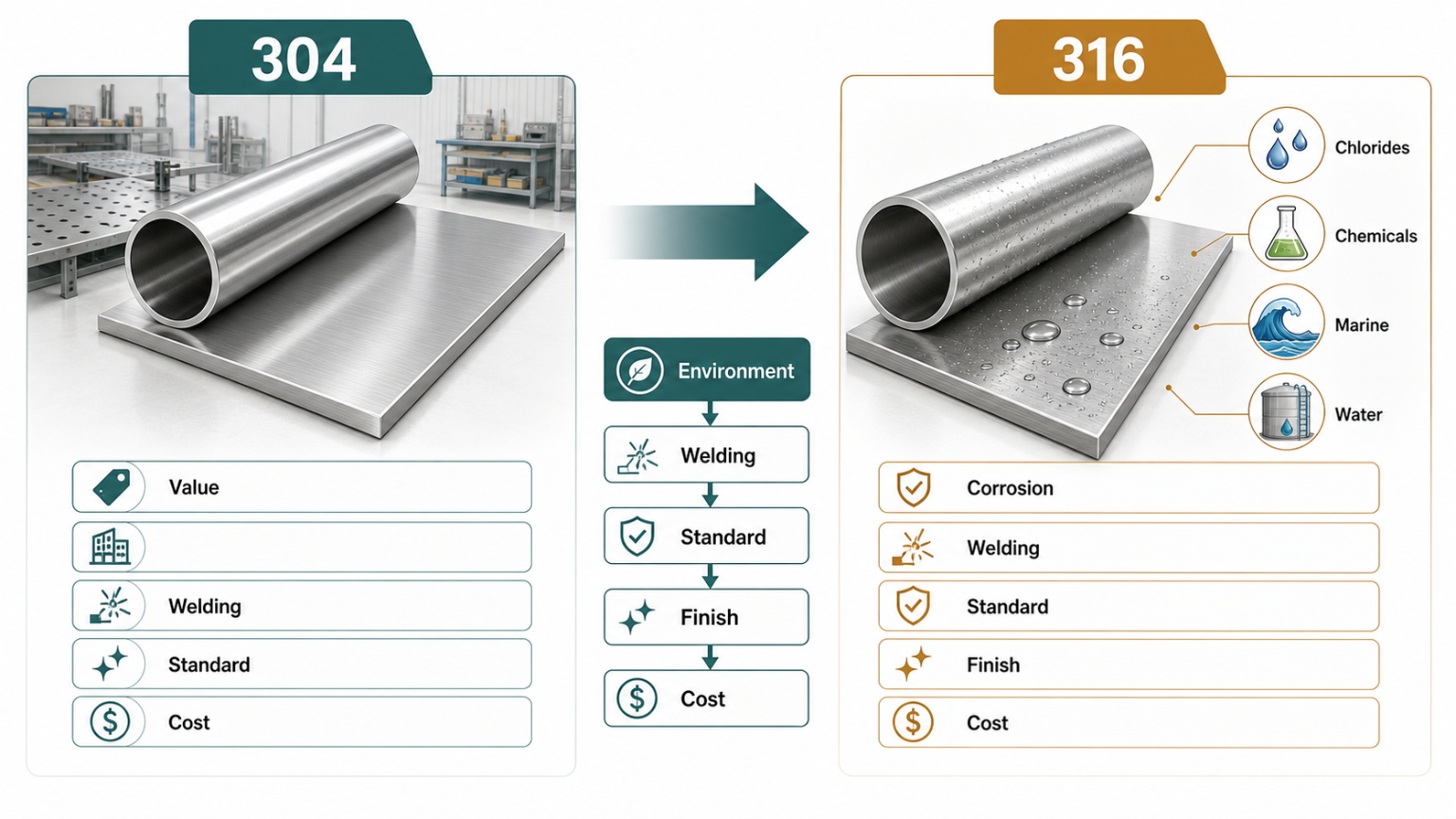
For real purchasing, I would not stop at the grade. I would confirm grade, product standard, dimensions, tolerances, surface finish, welding requirements, certificate needs, PMI requirements, and service environment. This protects the engineer, the buyer, and the supplier.
Conclusion
304 is the practical value choice for general stainless steel pipe and sheet applications, while 316 is the stronger corrosion-resistance choice when chlorides, chemicals, marine exposure, or water treatment conditions are present. The right answer depends on the environment first, then welding, standard, finish, and total cost.
At ZAIHUI Stainless Steel, we manufacture stainless steel pipes and sheets in Foshan, China, and we help buyers compare grades against real project conditions. If you are preparing an RFQ, send the application environment, grade, standard, dimensions, finish, and welding requirements so we can help you check the right stainless steel material before quoting.